How to Document Employee Knowledge With AI
What Happens When Your Best Employee Leaves? Use AI to Preserve Business Knowledge
Imagine this.
Your most experienced employee walks into your office tomorrow and tells you they're leaving.
They're giving you two weeks' notice.
You appreciate everything they've contributed, wish them well, and begin thinking about hiring their replacement.
But there's a bigger question you may not have considered.
What knowledge is about to walk out the door with them?
Not just their job description or responsibilities.
The practical knowledge they've accumulated over years of doing the work.
How they handle difficult customers.
How they prepare complicated quotes.
Which steps they follow when something goes wrong.
The exceptions they've learned to recognize.
And the countless small decisions that keep your business operating smoothly.
This knowledge may be essential to your business, but how much of it exists anywhere other than in that employee's head?
That's an operational risk many growing businesses underestimate.
The good news is that artificial intelligence can help address it.
Not by replacing your experienced employees, but by helping you capture, organize, and transfer their knowledge so others can learn from it.
The Hidden Risk of Undocumented Employee Knowledge
Every growing business develops ways of working that aren't necessarily written down.
Some of those processes evolve through experience.
Others are created informally because employees discover better ways to complete their work.
Over time, certain people become the organization's unofficial experts.
Consider a plumbing company where one employee knows exactly how to manage complex service estimates.
Or a healthcare practice where an experienced administrator understands every step of the patient intake process.
Or a coaching company where a team member knows how to coordinate onboarding, appointment scheduling, client communications, and follow-up.
These employees are valuable.
But when critical processes depend entirely on individual memory, the business becomes vulnerable.
Employees take vacations.
They become unavailable.
They move into different roles.
And eventually, some leave.
When they do, their undocumented operational knowledge may become difficult or expensive to reconstruct.
This can create inconsistent service, slower training, avoidable mistakes, and unnecessary dependence on owners or managers.
The objective isn't to make employees interchangeable.
It's to make important knowledge transferable.
Why Traditional SOP Documentation Often Fails
Most business owners understand the value of standard operating procedures.
They know that documenting processes can improve training, consistency, accountability, and business continuity.
Yet documentation frequently gets postponed.
Why?
Because creating an SOP takes time.
Someone has to observe the work, interview the employee, record the steps, organize the information, write clear instructions, and check everything for accuracy.
And in a busy business, there's always something more urgent competing for attention.
This is where AI can become useful.
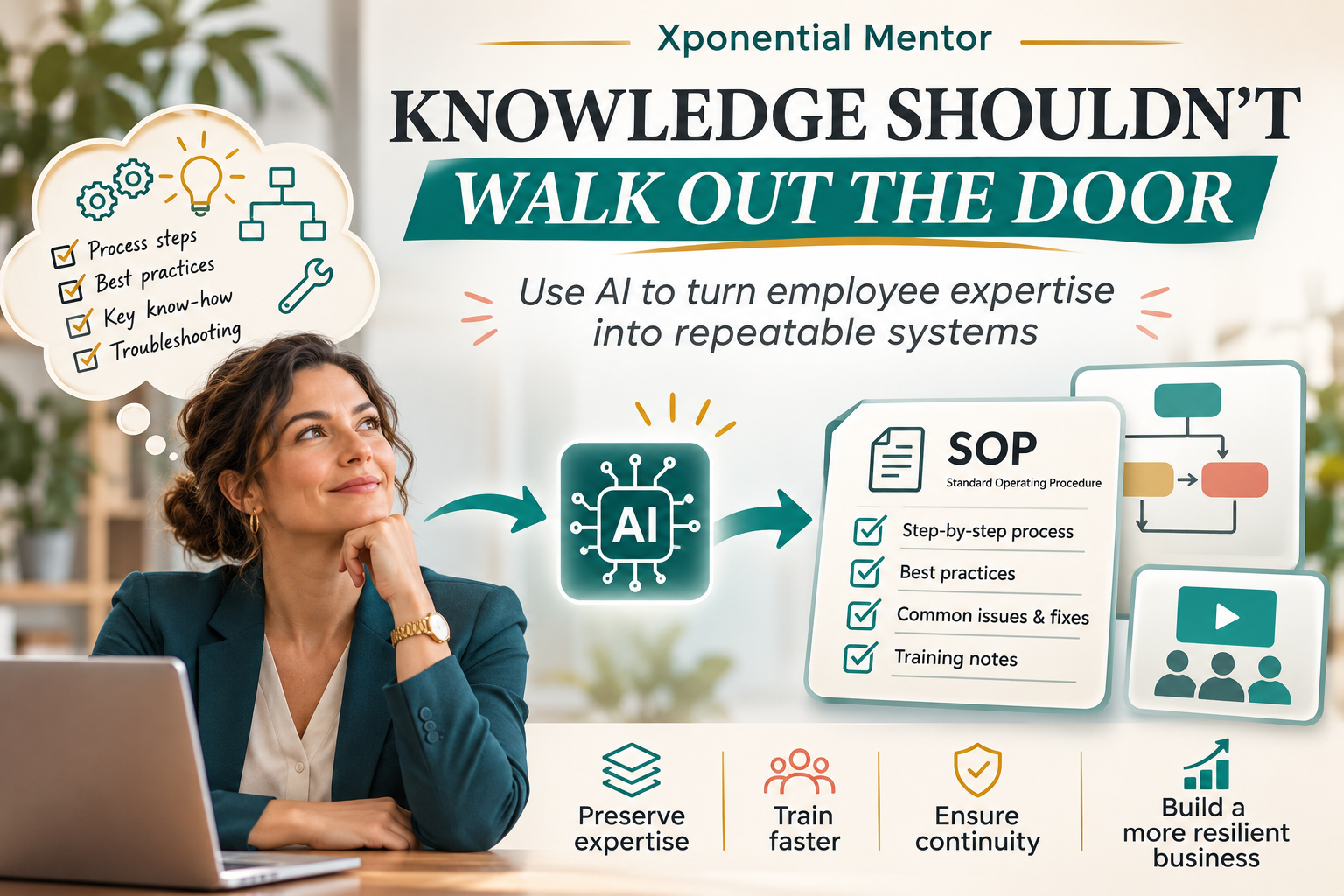
AI can help turn an employee's explanation into a structured first draft of a procedure.
That doesn't eliminate the need for human expertise.
It can reduce some of the administrative effort involved in organizing and formatting the information.
And it can help identify unanswered questions that might otherwise remain hidden.
A Five-Step Process for Turning Employee Knowledge Into an SOP Using AI
Here's a practical exercise you can begin with one process this week.
Step 1: Choose one important recurring process
Don't attempt to document your entire business at once.
Start with a task that is important, repeated frequently, and currently dependent on one experienced person.
Good candidates include:
Preparing customer estimates or quotes
Handling new customer inquiries
Scheduling appointments
Onboarding new clients
Processing routine service requests
Creating weekly management reports
Following up on outstanding proposals
Choose a process where improved documentation could make a measurable difference.
For a first test, avoid high-risk activities involving clinical decisions, sensitive personal data, regulated procedures, or safety-critical work.
Step 2: Capture how the employee actually performs the work
Ask the employee who performs the process successfully to explain what they do, step by step.
Don't just ask what the official procedure is.
Ask what really happens.
What triggers the task?
What information do they need?
What tools do they use?
What decisions do they make?
What happens when something doesn't go according to plan?
And how do they know the work has been completed correctly?
With permission, capture the explanation through written notes or a recording.
The objective is to understand the actual workflow, including exceptions and quality checks.
Step 3: Use AI to create the first draft
Once you have the explanation, remove confidential information, personal data, customer records, passwords, and other sensitive material.
Use an AI tool approved for your business's information-handling requirements.
Then provide a structured instruction.
Copy-and-paste AI prompt:
Act as a business process analyst.
Convert the following employee explanation into a clear Standard Operating Procedure (SOP).
Include:
Purpose and expected outcome
When the process starts
Required tools and information
Step-by-step instructions
Quality-control checkpoints
Exceptions and escalation rules
Missing information or questions requiring clarification
Do not invent missing details. Mark unverified steps as NEEDS CONFIRMATION.
Use language a new employee can understand.
Source explanation:
[PASTE NON-CONFIDENTIAL PROCESS NOTES HERE]
The resulting document is a draft.
It is not yet an approved SOP.
That distinction is important.
AI can organize information and propose a structure, but it can also misunderstand instructions or create plausible steps that weren't provided.
Step 4: Have an experienced employee verify the procedure
Return the draft to the person who performs the work.
Ask them to review each step.
Is anything missing?
Is the sequence correct?
Are there exceptions?
Are the required tools and permissions accurate?
Are the quality checks sufficient?
Does the process comply with your industry's requirements?
Correct the document before proceeding.
For regulated or higher-risk activities, the appropriate qualified professional must review the procedure.
Step 5: Test whether another qualified employee can follow it
This is the step many businesses overlook.
A document is not necessarily a usable procedure.
Ask another qualified employee to follow the SOP in a supervised, appropriate setting.
Observe where they hesitate.
Which instructions are unclear?
What information is missing?
Where do they need to ask questions?
Which decisions require additional training or authority?
Use those observations to improve the document.
Then assign a process owner, approve the final version, and establish when it will be reviewed.
The objective is not simply to create documentation. It's to create a repeatable process that can be performed correctly.
What Does This Look Like in a Growing Service Business?
Imagine an HVAC company where one experienced coordinator manages complicated customer estimates.
The owner realizes that when this person is away, estimates take longer to prepare and other employees frequently need assistance.
Instead of attempting to automate the entire process immediately, the business starts by documenting it.
The coordinator explains the workflow.
An approved AI tool organizes the explanation into a draft procedure.
The coordinator verifies the steps.
Another trained employee tests the instructions using an appropriate example.
The team identifies missing information, improves the document, and creates a clear escalation point for unusual cases.
The business now has a more transferable process.
This is an illustrative scenario, not a claimed client result.
The same general approach can be applied to suitable administrative processes in healthcare practices, professional coaching businesses, trades, and other service organizations.
How Do You Know Whether the New SOP Is Working?
Creating documents is not the business outcome.
Improving operational performance is.
Before introducing the SOP, establish a baseline.
You might measure:
Training time: How long does it take a qualified new employee to learn the process?
Error rate: How frequently does the task need correction or rework?
Completion time: How long does the process typically take?
Escalations: How often does the employee need help from a manager or owner?
Consistency: Can qualified team members achieve the required standard using the documented procedure?
Then measure the same indicators after implementation.
If the SOP improves performance, you have evidence of its operational value.
If not, investigate what's missing.
You may discover that documentation alone isn't sufficient and that additional training, clearer authority, or a redesigned process is required.
The Bigger Opportunity: Building a Business That Can Grow
This is where the conversation becomes bigger than AI.
Many owners want to grow and scale their businesses.
But growth can expose weaknesses in how work gets done.
When knowledge is concentrated in a few people, adding employees or customers doesn't automatically create more capacity.
Sometimes it creates more questions, more interruptions, and more dependence on the owner.
Documenting important processes is one way to begin changing that.
It helps you identify what should be standardized, what requires human judgment, what employees need to learn, and where technology might support better execution.
AI can accelerate parts of the documentation process.
But the real business value comes from making expertise transferable and operations more dependable.
And that's business architecture.
Your Challenge: Document One Process This Week
Choose one important recurring process that currently depends on someone's experience or memory.
Ask them to explain how it works.
Use an approved AI tool to create a draft SOP.
Verify it with an experienced employee.
Then test whether another qualified team member can use it successfully.
You don't need to document everything this week.
Start with one meaningful process.
And ask yourself:
If this employee were unavailable tomorrow, would someone else know what to do?
If the answer is no, you've identified a worthwhile place to begin.
Ready to Build a Business That Doesn't Depend on Everyone Remembering Everything?
At Xponential Mentor, we work with growth-minded business owners to strengthen their business systems, improve operations, and identify where AI and technology can create meaningful value.
If you're recognizing that too much of your company's knowledge lives in people's heads, let's have a conversation.
We'll explore where your business is today, what's limiting your capacity, and whether we're the right fit to help you build what comes next.
Book a 30-minute conversation with Alison:
https://xponentialmentor.com/talk
The wealth is in the relationship.
Alison A. Stewart
Co-Founder, Xponential Mentor