GTA 6 Launches Today: What Business Owners Can Learn About Building Demand
Grand Theft Auto VI launches on November 19, 2026, and there's an important business lesson here that has nothing to do with video games.
Rockstar Games didn't wait until launch day to introduce people to what it was creating.
The company spent years building anticipation for GTA VI through trailers, previews, announcements, and a coordinated promotional campaign.
By the time the game became available, millions of people were already familiar with the product.
That doesn't mean every business can—or should—follow Rockstar's playbook.
Most businesses don't have a globally recognized brand, an established franchise, or a marketing budget of that scale.
But there is a pattern worth understanding:
Successful launches don't have to begin on the day something becomes available.
For growth-minded business owners, the more important question is:
Are you creating something people have demonstrated they want—or are you building something and hoping customers will eventually buy it?
The Difference Between Attention and Actual Demand
Let's examine a mistake I see businesses make.
An owner comes up with an idea for a new service, product, or program.
They become excited about its potential.
They invest time developing it.
They create the branding, build the website, prepare the promotional materials, and put the systems in place.
Then they announce the launch.
And wait.
Sometimes, the response is disappointing.
Not necessarily because the product is bad.
The business may simply have failed to establish whether enough qualified customers have a problem they want solved, value the proposed outcome, and are prepared to pay for it.
There's an important distinction here.
Attention is not the same as demand.
Someone might like your social media post.
They might compliment your new offer.
They might tell you that your idea sounds fantastic.
None of those responses guarantees they're willing to become a customer.
Demand becomes more credible when people take meaningful action.
That might mean paying for a pilot, placing a refundable deposit under clear terms, signing a suitable agreement, or committing time and resources to a serious buying conversation.
The appropriate commitment depends on your business and industry.
The principle is that you should look for behaviour—not just enthusiasm.
What GTA VI Demonstrates About Building Anticipation
GTA VI provides a high-profile example of coordinated prelaunch marketing.
Rockstar released its first trailer in December 2023, followed by additional trailers, previews, preorder opportunities, and launch communications leading up to November 19, 2026.
The campaign gave prospective customers opportunities to become familiar with the product long before its release.
However, there's an important limitation to this comparison.
Rockstar already had extensive demand for its established franchise. Its campaign helped engage that existing audience and communicate the upcoming release.
A smaller business without an established audience must first validate that the underlying problem and proposed solution matter to potential customers.
In other words, don't copy the marketing scale.
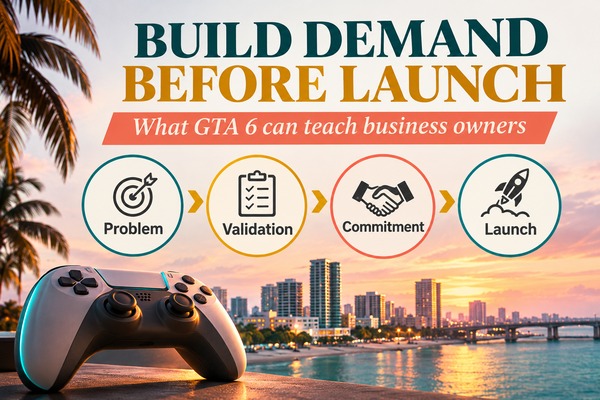
Understand the sequence.
Find the problem.
Test the proposed solution.
Build informed interest.
Then launch.
Step 1: Identify the Problem Before Building the Solution
Imagine you're considering introducing a new maintenance program for your HVAC company.
You think customers would appreciate predictable service, fewer unexpected breakdowns, and more convenient scheduling.
Those might be attractive benefits.
But before investing heavily in the program, you need to understand the actual customer problem.
Start by speaking with ten people who resemble your ideal buyers.
Ask questions such as:
What is your biggest frustration with maintaining your heating and cooling systems?
What have you already tried to address it?
What have unexpected repairs or service interruptions cost you?
What would make preventative maintenance more valuable?
What concerns would prevent you from joining a maintenance program?
Notice what we're not doing.
We're not asking, "Do you like my idea?"
That question often produces polite responses rather than useful evidence.
Instead, we're learning about the customer's current situation, previous behaviour, and willingness to solve the problem.
The same approach applies to a healthcare practice considering a new administrative service, a coach developing a group program, or a service company introducing a new subscription offering.
The goal is to understand a real problem before committing significant resources to a solution.
Step 2: Test the Offer Before You Build Everything
Once you've identified a recurring problem, the next step is to test your proposed offer.
Be specific.
What result will the customer receive?
What is included?
What does it cost?
Who is it designed for?
And what commitment are you asking the customer to make?
For example, a coaching business might be considering a new leadership development program.
Instead of recording twenty lessons and building an entire online platform before testing demand, the owner could offer a small paid pilot to a qualified group of clients.
The pilot might reveal that customers want practical decision-making support rather than a traditional course.
That information could fundamentally change how the offer is developed.
Or the pilot might reveal insufficient willingness to pay.
That's useful information, too.
You have potentially avoided investing in something that won't deliver an adequate return.
A small, well-designed test can reveal more than months of speculative development.
Be careful with the interpretation, however.
Ten conversations are a useful starting point, not statistical proof of market demand.
And a handful of positive responses doesn't establish product-market fit.
Treat early conversations and pilot commitments as evidence to guide your next decision, not as a guarantee of success.
Step 3: Build Anticipation by Providing Value
Once you've established that a problem matters and your proposed solution has genuine potential, begin building informed interest.
This is where content can support your business strategy.
Rather than posting only promotional announcements, demonstrate that you understand the problem.
Explain why it occurs.
Discuss the consequences of leaving it unresolved.
Show the decisions customers need to make.
Offer practical insights people can use immediately.
Share what you're learning as you develop the solution, while respecting customer privacy and confidentiality.
For example, a plumbing business preparing to introduce an annual maintenance plan might publish content explaining common maintenance problems, preventative inspections, and the cost considerations homeowners should understand.
This content can attract people already interested in solving the problem.
It also allows the business to discover which questions, concerns, and benefits matter most.
Over time, these interactions can become valuable inputs into the offer.
But don't measure success only by reach.
Track signals that indicate qualified interest.
Five Measures That Tell You Whether Demand Is Developing
If you're considering launching a product or service, I recommend watching five indicators.
1. Qualified customer conversations
How many conversations have you had with people who fit your intended customer profile?
And what recurring problems are they describing?
2. Existing spending
Are customers already spending money, time, or resources attempting to solve the problem?
Existing spending can be useful evidence that the problem has economic significance.
3. Offer interest
When you describe your proposed solution and price, how many people want to explore it seriously?
Distinguish casual interest from meaningful buying conversations.
4. Customer commitments
How many qualified prospects are prepared to make an appropriate commitment?
Depending on your offer, that could be a paid pilot, signed agreement, deposit, or another substantial next step.
5. Conversion into revenue
Ultimately, how many prospective buyers become paying customers, and does the offer generate an acceptable financial return?
Revenue matters more than the appearance of popularity.
You can have a highly viewed launch announcement that generates few qualified opportunities.
Or a relatively small audience that produces valuable client relationships.
For an established service business, the second outcome may be far more commercially important.
A Practical Seven-Day Demand Validation Exercise
Here's an exercise you can use before launching your next major offer.
Days 1–2: Define the problem.
Write down the customer segment, the problem you're solving, and the outcome you believe customers want.
Identify ten people who fit the audience.
Days 3–4: Have customer conversations.
Discuss their existing challenges, alternatives, buying decisions, and current spending.
Document what they say without trying to force agreement with your idea.
Day 5: Design a small offer test.
Present a specific solution, scope, and price.
Choose a realistic commitment appropriate for the service.
Day 6: Ask for commitment.
Invite qualified prospects to take the next step.
Record actual decisions and objections rather than just positive reactions.
Day 7: Review the evidence.
What problem came up repeatedly?
What surprised you?
Where did potential buyers hesitate?
What commitments did you secure?
And what should you test next?
Seven days won't validate every market or business model.
But it can provide a disciplined starting point before committing to a larger investment.
The Bigger Business Lesson From GTA VI
The lesson isn't that every business needs a massive promotional campaign.
It isn't that every launch should take years.
And it certainly isn't that having an enormous online audience guarantees commercial success.
The valuable pattern is the relationship between customer understanding, anticipation, commitment, and execution.
A business needs to know what its customers value.
It needs an offer that addresses a meaningful problem.
It needs a practical method for testing whether customers will act.
And it needs the operational capacity to deliver what it promises.
When those pieces work together, marketing becomes part of a stronger business system rather than a last-minute attempt to attract attention.
Don't wait until you're finished building to discover whether people want what you're creating.
Your Challenge: Validate One Business Opportunity
Think about one service, product, or program you've been considering introducing.
Before spending more time or money developing it, ask yourself:
What evidence do I have that customers want this?
Have you spoken with prospective buyers?
Do you understand what they're currently doing to solve the problem?
Have you tested your proposed offer?
Have any qualified customers made a meaningful commitment?
If not, that's your next step.
Have ten conversations.
Look for patterns.
Test an offer.
Use the evidence to decide what to build next.
Ready to Make Better Business Growth Decisions?
At Xponential Mentor, we work with established service businesses to strengthen business strategy, improve operating systems, evaluate opportunities, and use AI and technology where they create measurable value.
If you're considering a new offer, service, or growth initiative and want to make sure you're solving the right problem, let's have a conversation.
Book a 30-minute conversation with Alison:
https://xponentialmentor.com/talk
The wealth is in the relationship.
Alison A. Stewart
Co-Founder, Xponential Mentor